Russian Black Sea Fleet in 2026, Driven From Sevastopol and Locked In by the Bosporus
On 2 March 2026 the Russian minesweeper Valentin Pikul sank at its berth in Novorossiysk, according to Ukraine's defence ministry. It wasn't a famous ship. But where it sank says a lot. Novorossiysk, on Russia's own coast, is where the Black Sea Fleet moved after Ukraine made its historic base at Sevastopol in Crimea too dangerous to use. Four and a half years into the full-scale war, the fleet that was supposed to blockade Ukraine has been hunted across its own sea by a country with almost no navy.
A fleet in retreat
The turning point came early. On 13 April 2022 two Ukrainian Neptune missiles hit the flagship, the cruiser Moskva, which sank the next day under tow; it was the largest warship lost in combat since the Second World War. Russia did not officially admit the cause for almost four years.
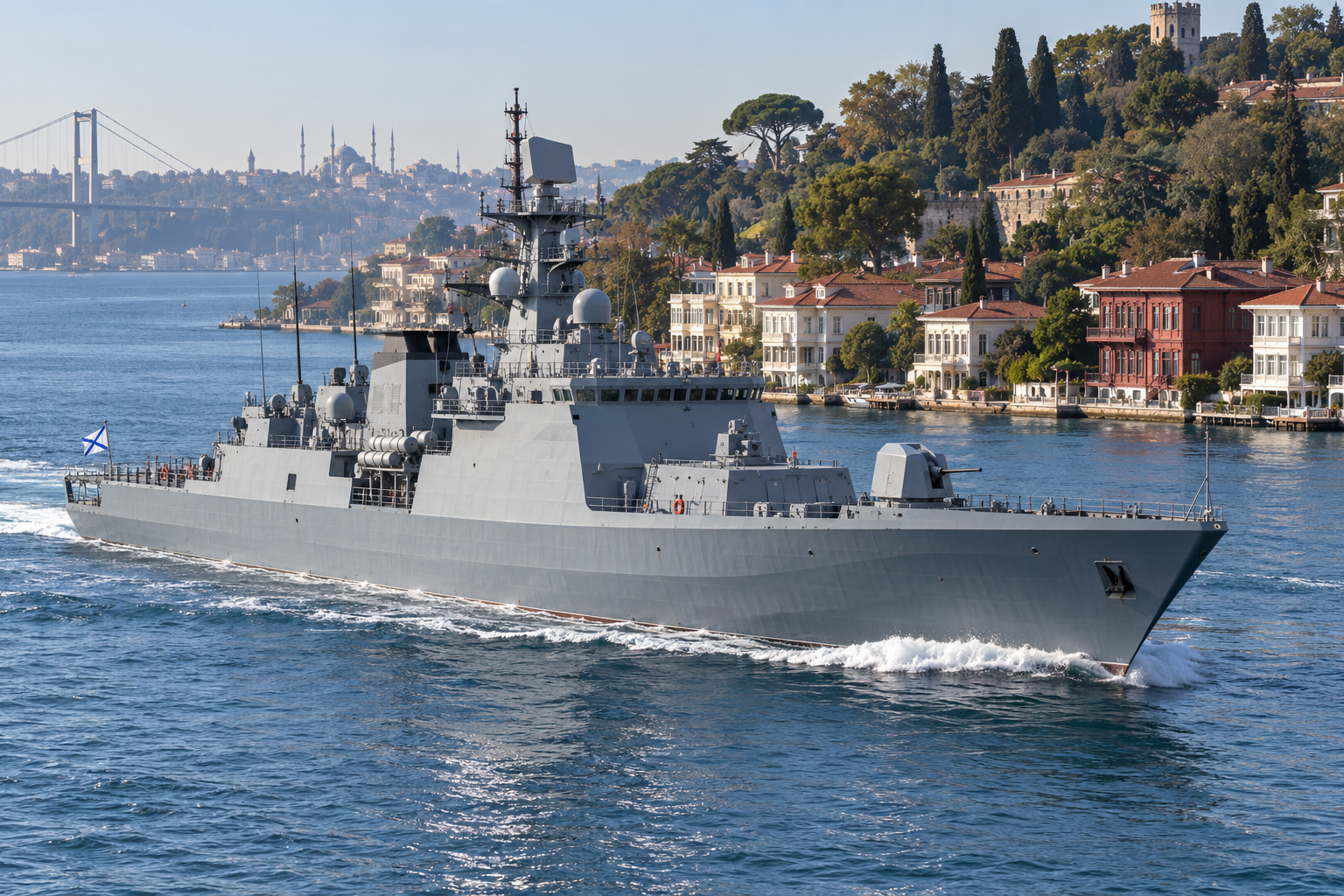
Image: pxef.com
The losses kept coming. Ukraine's defence ministry lists the landing ships Saratov (March 2022), Novocherkassk (December 2023) and Tsezar Kunikov (February 2024), the missile corvettes Ivanovets (January 2024) and Tsiklon (May 2024), the patrol ship Sergey Kotov (March 2024), and the submarine Rostov-on-Don, hit in dry dock in Sevastopol in September 2023. Another Kilo-class submarine was badly damaged by Ukrainian underwater drones in December 2025. By early 2026 Ukraine estimated that about 30 percent of the fleet's combat strength had been destroyed or seriously damaged. These are Ukrainian claims, though many of the sinkings have been confirmed by satellite imagery.
The weapons changed naval warfare. Cheap Ukrainian sea drones, cruise missiles and long-range strikes made Crimea's harbours unsafe, and much of the surviving fleet moved east to Novorossiysk in 2023 and 2024. Ukraine then followed it there.
Why Russia can't reinforce it
In a normal war Russia would simply send replacements from its Northern or Baltic fleets. It can't, because of the Bosporus. Since 28 February 2022 Turkey has applied Article 19 of the Montreux Convention: warships of countries at war may not pass the Turkish Straits except to return to their home base. Russian ships that were in the Mediterranean in 2022 could go home; nothing new can come in. Turkey refused a Russian request to send four warships through in the early weeks of the war.
The rule cuts both ways. Russian Black Sea ships that leave can't come back in to fight, so Moscow has kept most of them where they are. And Ukraine's own new ships, minehunters donated by Britain, Belgium and the Netherlands, are stuck in Portsmouth for the same reason.
That makes the Black Sea a closed box. Russia fights with what it had in February 2022, minus its losses, plus whatever small craft it can build in its Black Sea and Azov yards or bring in by inland waterways from the Caspian.
What the fleet still does
The fleet hasn't vanished. Its remaining frigates and submarines still fire Kalibr cruise missiles at Ukrainian cities from relatively safe waters. And in 2026 Russia found a new way to fight at sea without risking big ships: since early October, drones have struck at least seven merchant ships off Romania and Bulgaria, most of them carrying Ukrainian trade, with dozens of sailors dead or missing (Black Sea war and shipping). Bulgaria's prime minister said the logic of the attacks pointed to Moscow.
For Turkey, the fleet's weakness is a mixed blessing. A smaller Russian navy means less pressure on the straits. But Recep Tayyip Erdoğan has also used the balance to keep his options open with Moscow, buying Russian oil and letting Russia's shadow tankers pass (the shadow fleet) while keeping NATO's big ships out under the treaty.
When the war ends, the question will be what Russia is allowed to bring back through the Bosporus. The answer will be Turkey's to give.