Bosporus Pilotage, Why Pilots Are Optional in the Strait and Why Most Ships Take One Anyway
At about ten past seven on the evening of 11 October 2026, the Maltese-flagged tanker Ivyan lost her engine in the middle of the Bosporus. The 100-metre ship was carrying about 6,000 tonnes of vegetable oil from Varna to Italy, and with no propulsion she began to drift towards the Asian shore at Kanlıca, its ferry pier and its old waterfront houses. The crew dropped anchor and stopped her short of the shore. Turkey's Coastal Safety authority sent the rescue tugs Kurtarma-7 and Kurtarma-11 and lifeboats, traffic was halted in both directions, and the tanker was towed out to the Küçükçekmece anchorage in the Sea of Marmara. Nobody was hurt.
A Turkish pilot was on board. That's the part of the story that rarely makes the news, and it matters.
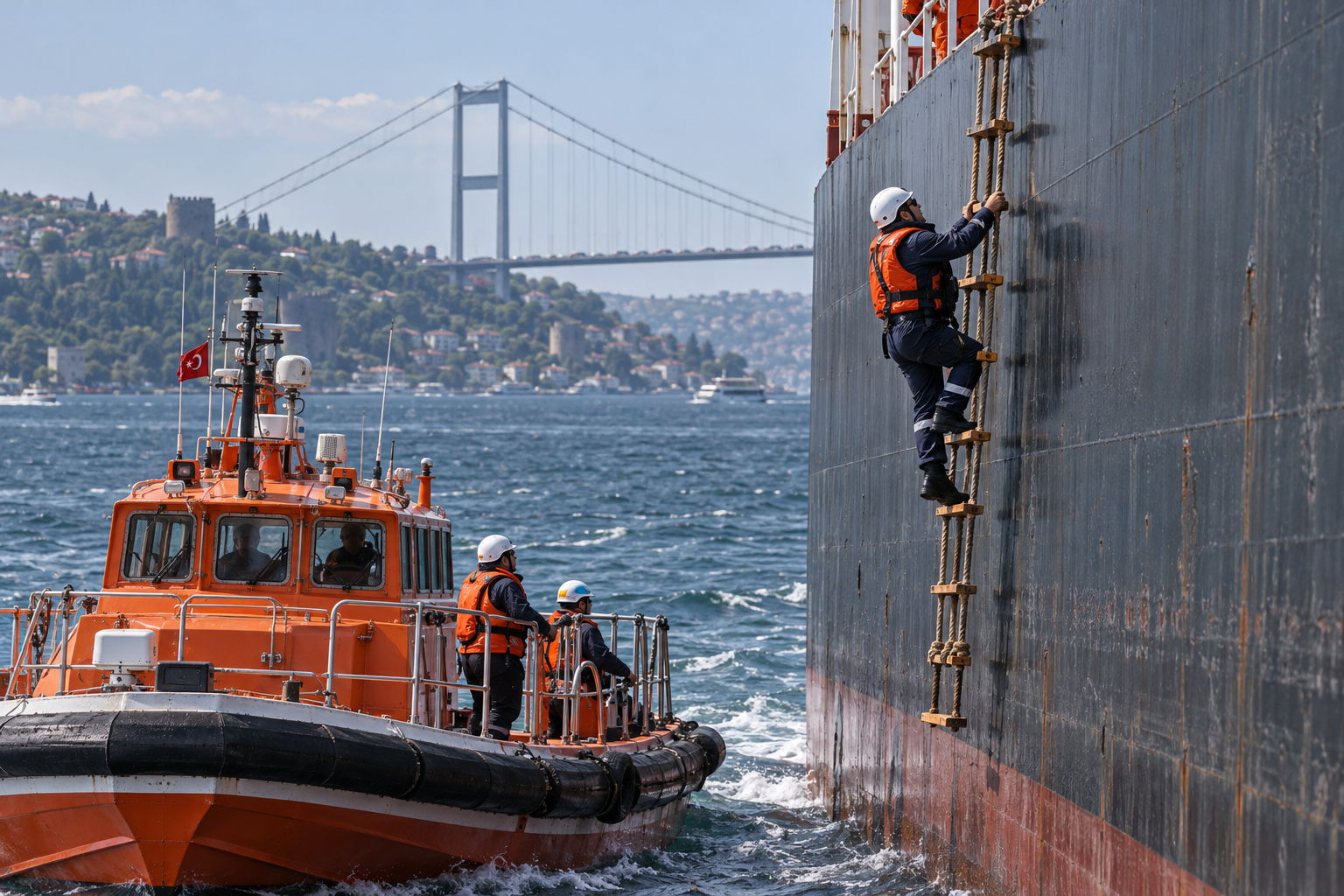
Image: pxef.com
Optional by treaty
Under the Montreux Convention, merchant ships have freedom of passage through the Turkish Straits in peacetime. Turkey can't force them to stop, and it can't make pilotage compulsory for ships in transit. It can only offer it. Ships passing straight through decide for themselves.
Most of them now say yes. In 2025, 24,608 of the 40,172 ships that transited the Bosporus took a pilot, 61.3 percent, according to Turkey's transport ministry. In the first half of 2026 the share rose to about 64 percent (the half-year figures).
Who the pilots are
Pilotage in the straits is run by the state-owned Directorate General of Coastal Safety, known in Turkish as Kıyı Emniyeti. It also runs the rescue tugs and the salvage service, while traffic controllers in Istanbul track every ship from the Black Sea entrance to the Sea of Marmara. Pilots board near either end of the strait and take the ship through the bends at Kandilli and Yeniköy, where the current can run at seven knots or more (the strait in numbers).
The service is not cheap and it is not meant to be. The base charge rose to 550 dollars from 1 January 2025, plus 100 dollars for every 1,000 gross tons. A large tanker pays several thousand dollars for one transit. Ships also pay Turkey's lighthouse and rescue fee, which rose to 6.70 dollars per net ton on 1 July 2026, against 80 cents for nearly forty years before 2022 (traffic and transit rules).
The salvage catch
A pilot doesn't change who commands the ship. The master stays responsible, and the pilot advises. Where the system bites is salvage. Coastal Safety holds the monopoly on rescue tugs in the straits, and a ship that loses power and takes a tug line can face a salvage claim rather than a towage bill, under terms set in Turkey. Protection and indemnity clubs remind their members to test engines and steering before entering the strait for exactly that reason.
Breakdowns are routine. In December 2024 the empty crude tanker Cordelia Moon, 274 metres long and bound for Novorossiysk, lost her engine off Beykoz and was towed to Ahırkapı. The Ivyan was the latest of several such stoppages. Each time the risk is the same as in the great accidents of the past: a laden ship adrift in a city of 16 million.
Why the share keeps rising
Ships through the Bosporus are getting fewer and bigger. Many of the tankers coming out of the Black Sea are old shadow-fleet ships carrying Russian oil under sanctions, with crews and owners that are hard to trace (the shadow fleet). Turkey can't refuse them passage. It can watch them, offer them a pilot, and keep its tugs close.
The Ivyan's anchors held. The pilots and tugs will be needed again.